



Marie Lapre Grabon
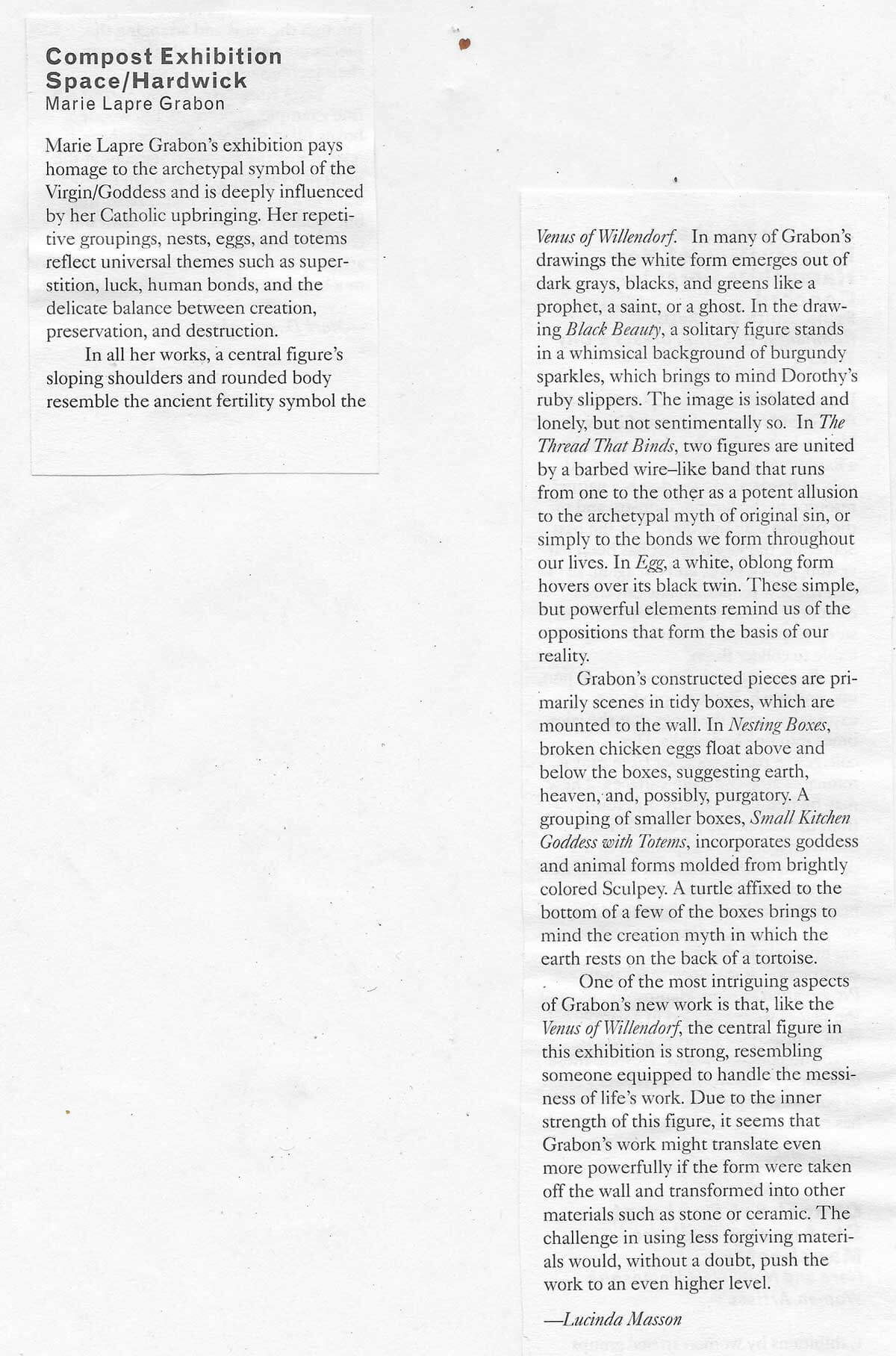
Marie Lapre Grabon’s exhibition pays homage to the archetypal symbol of the Virgin/Goddess and is deeply influenced by her Catholic upbringing. Her repetitive groupings, nests, eggs, and totems reflect universal themes such as superstition, luck, human bonds, and the delicate balance between creation, preservation, and destruction.
In all her works, a central figure’s sloping shoulders and rounded body resemble the ancient fertility symbol the Venus of Willendorf. In many of Grabon’s drawings the white form emerges out of dark grays, blacks, and greens like a prophet, a saint, or a ghost. In the drawing Black Beauty, a solitary figure stands in a whimsical background of burgundy sparkles, which brings to mind Dorothy’s ruby slippers. The image is isolated and lonely, but not sentimentally so. In The Thread That Binds, two figures are united by a barbed wire-like band that runs from one to the other as a potent allusion to the archetypal myth of original sin, or simply to the bonds we form throughout our lives. In Egg, a white, oblong form hovers over its black twin. These simple, but powerful elements remind us of the oppositions that form the basis of our reality.
Gabon’s constructed pieces are primarily scenes in tidy boxes, which are mounted to the wall. In Nesting Boxes, broken chicken eggs float above and below the boxes, suggesting earth, heaven, and, possibly, purgatory. A grouping of smaller boxes, Small Kitchen Goddess with Totems, incorporates goddess and animal forms molded from brightly colored Sculpey. A turtle affixed to the bottom of a few of the boxes brings to mind the creation myth in which the earth rests on the back of a tortoise.
One of the most intriguing aspects of Grabon’s new work is that, like the Venus of Willendorf, the central figure in this exhibition is strong, resembling someone equipped to handle the messiness of life’s work. Due to the inner strength of this figure, it seems that Gabon’s work might translate even more powerfully if the form were taken off the wall and transformed into other materials such as stone or ceramic. The challenge in using less forgiving materials would, without a doubt, push the work to an even higher level.
-Lucinda Masson