



Doug LeBrun
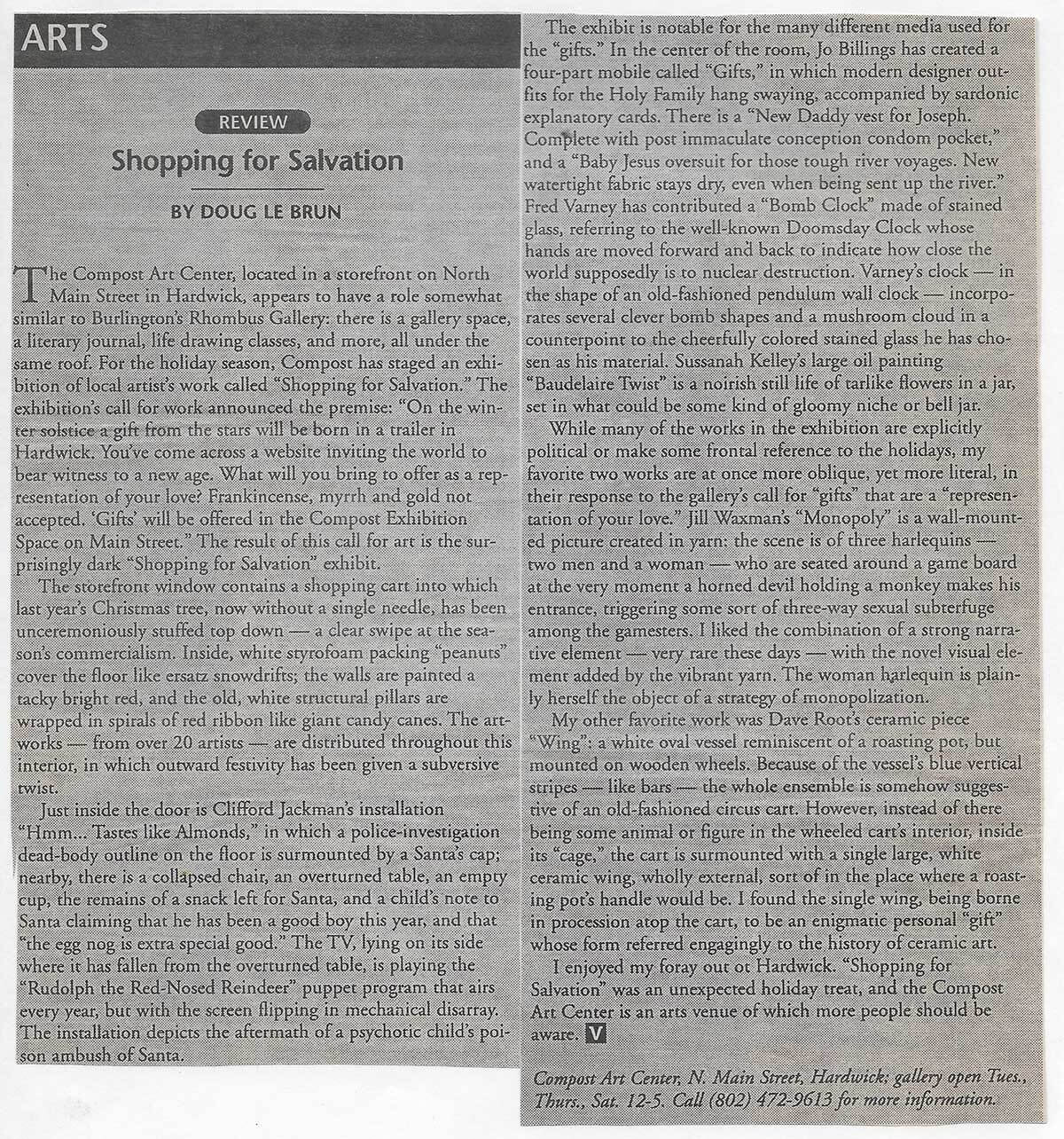
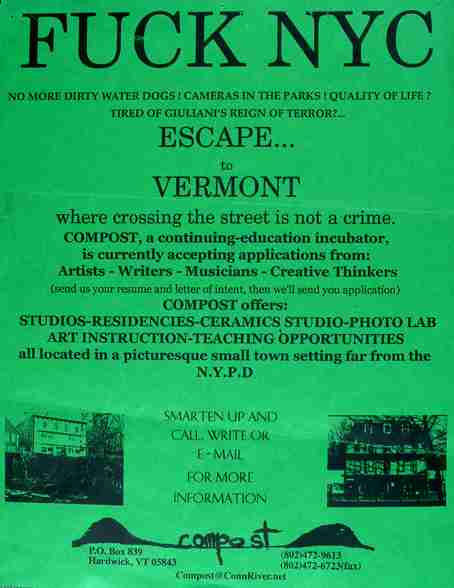
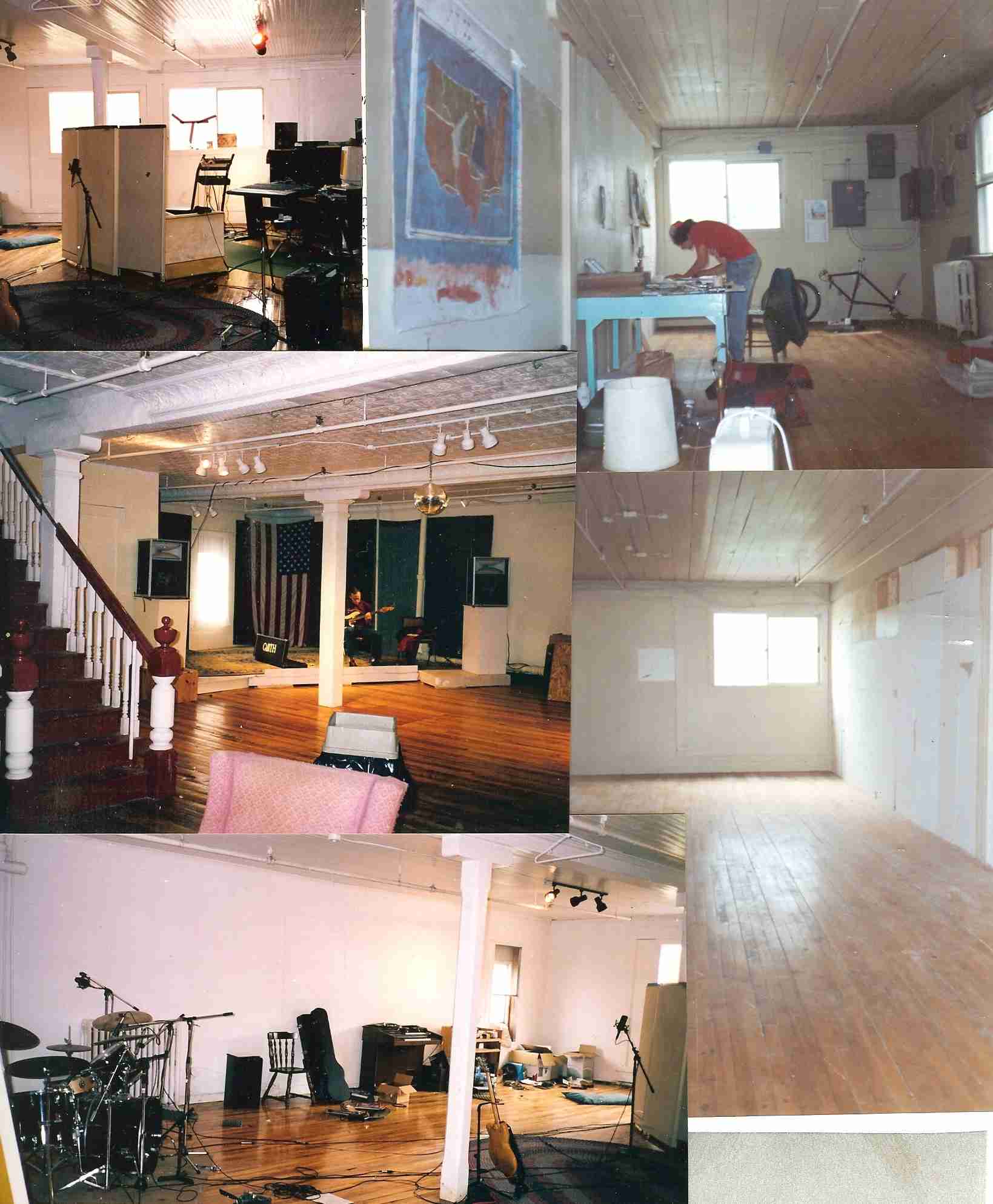
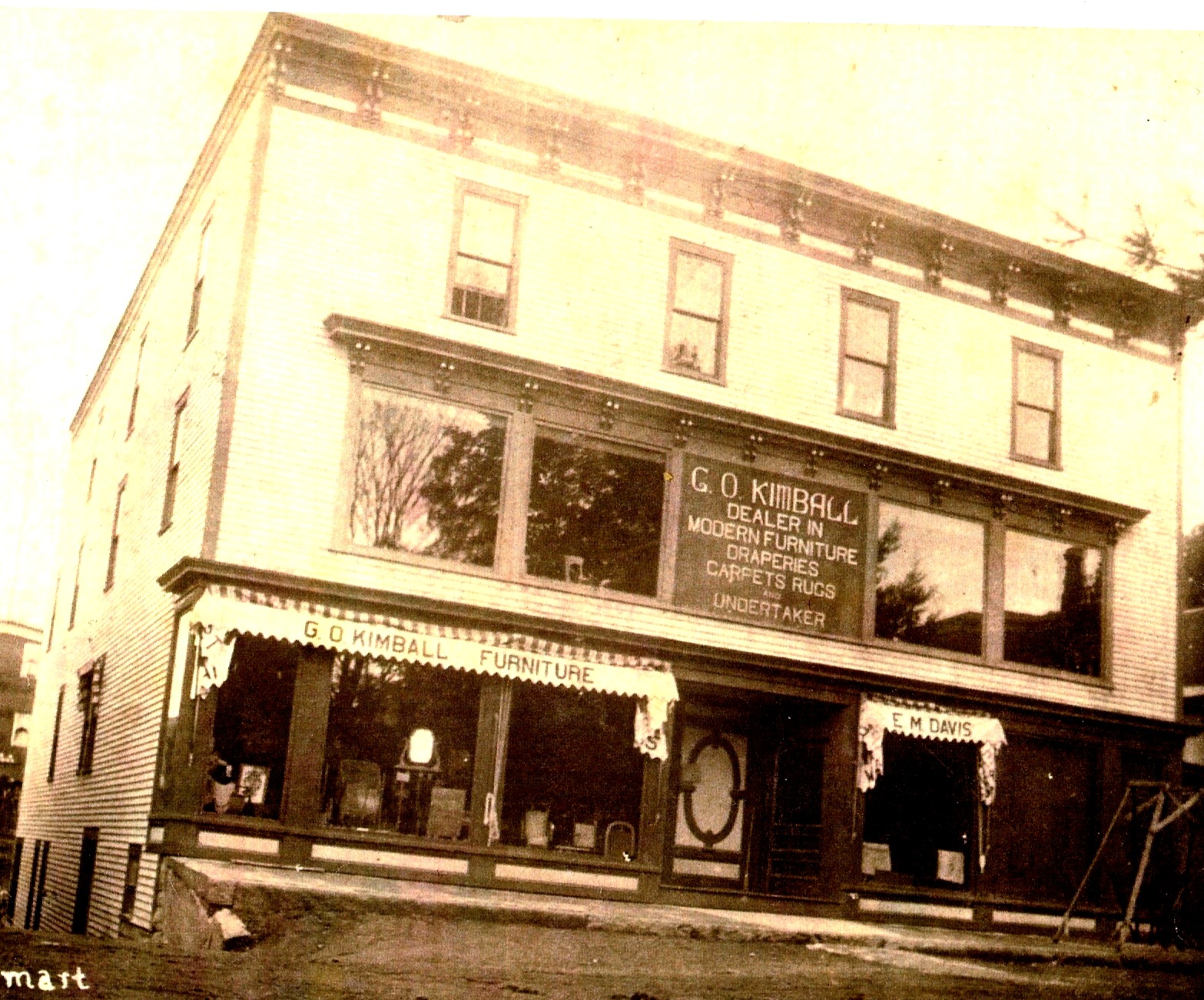
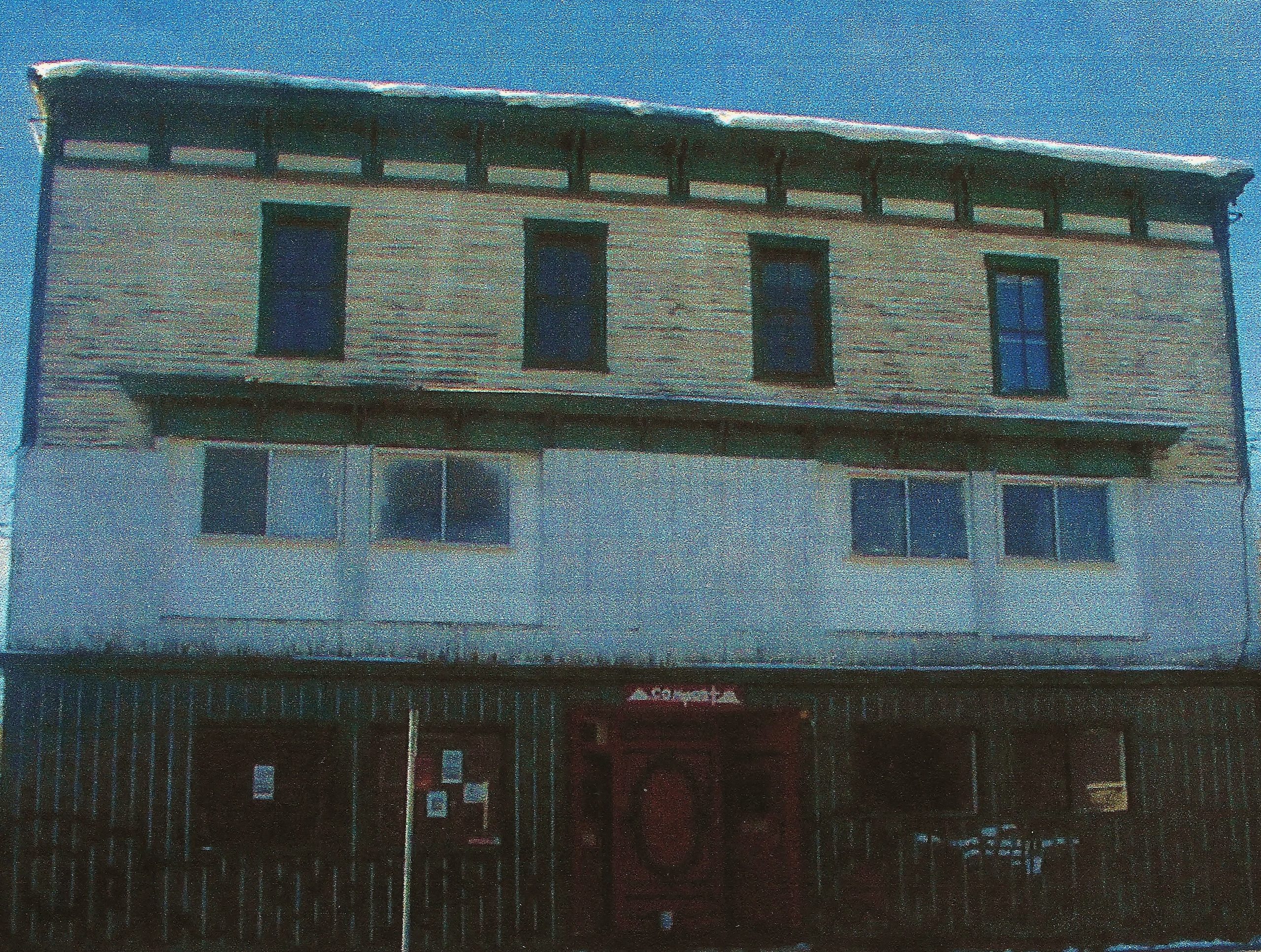
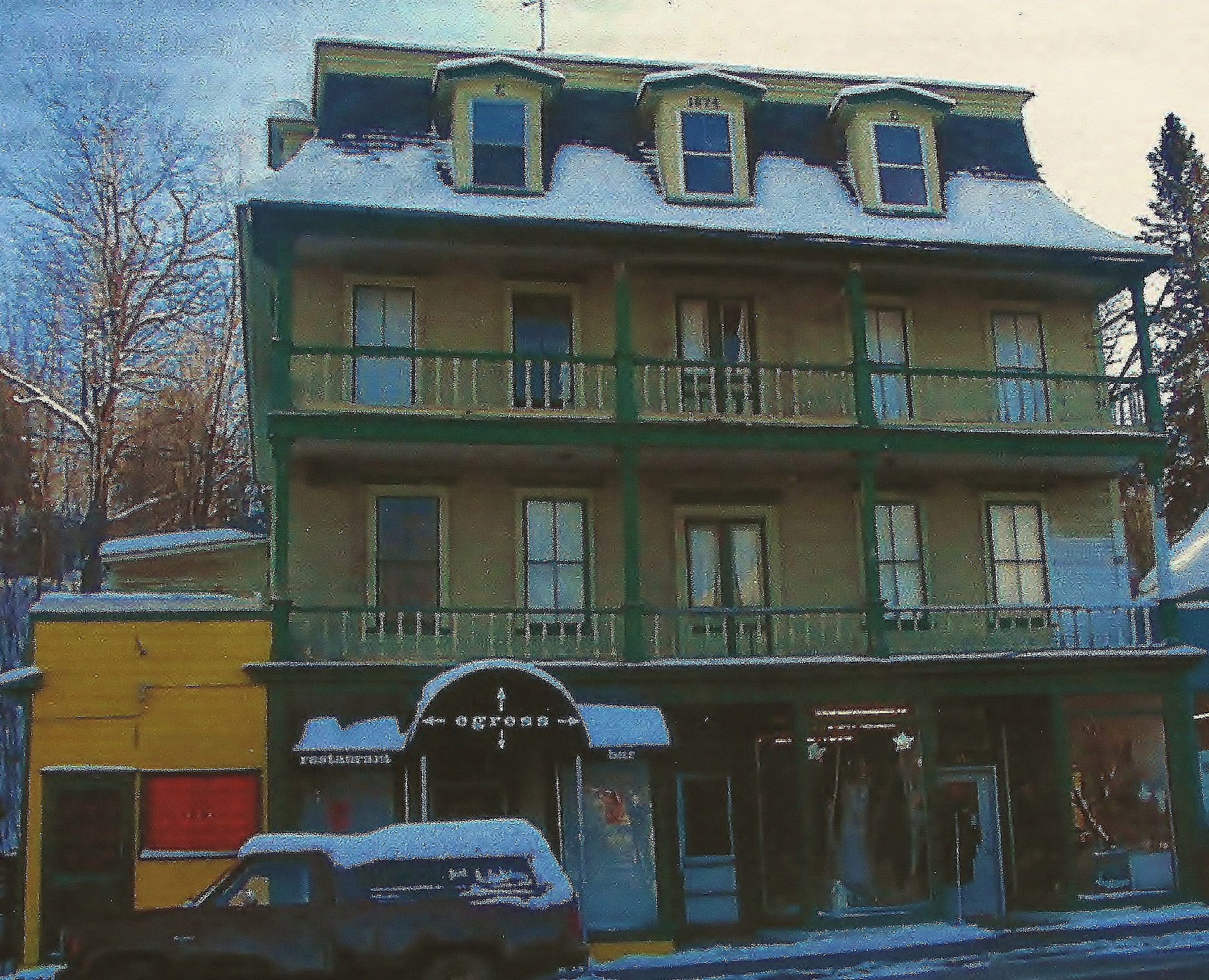
The Compost Art Center, located in a storefront on North Main Street in Hardwick, appears to have a role similar to Burlington’s Rhombus Gallery: there is a gallery space, a literary journal, life drawing classes, and more, all under the same roof. For the holiday season, Compost has staged an exhibition of local artists work called “Shopping for Salvation.” The exhibition’s call for work announced the premise: “On the winter solstice a gift from the stars will be born in a trailer in Hardwick. You’ve come across a website inviting the world to bear witness to a new age. What will you bring to offer as a representation of your love? Frankincense, myrrh and gold not accepted. ‘Gifts’ will be offered in the Compost Exhibition Space on Main Street.” The result of this call for art is the surprisingly dark “Shopping for Salvation” exhibit.
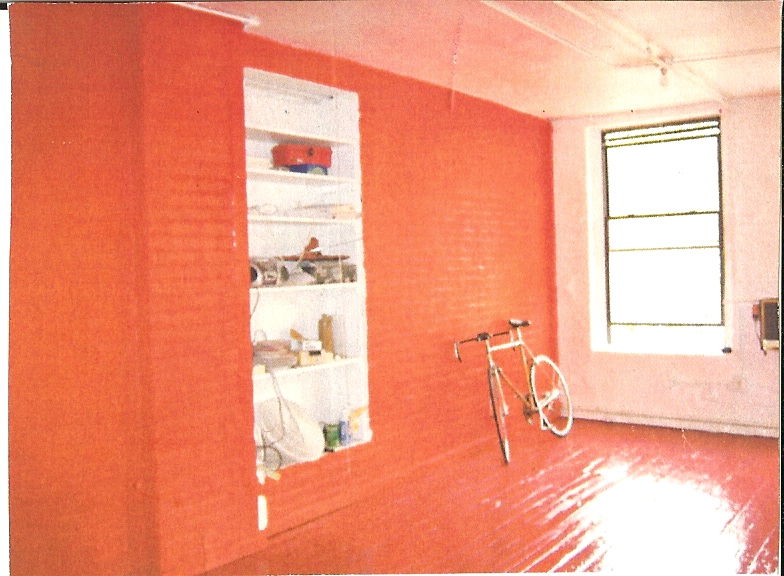
The storefront window contains a shopping cart into which last year’s Christmas tree, now without a single needle, has been unceremoniously stuffed top down a clear swipe at the sea- son’s commercialism. Inside, white Styrofoam packing peanuts cover the floor like ersatz snowdrifts, the walls are painted a tacky bright red, and the old, white structural pillars are wrapped in spirals of red ribbon like giant candy canes. The art works from over 20 artists are distributed throughout this interior, in which outward festivity has been given a subversive twist.
Just inside the door is Clifford Jackman’s installation “Hmm. Tastes like Almonds,” in which a police-investigation dead -body outline on the floor is surmounted by a Santa’s cap; nearby, there is a collapsed chair, an overturned table, an empty cup, the remains of a snack left for Santa, and a child’s note to Santa claiming that he has been a good boy this year, and that “the eggnog is extra special good” The TV, lying on its side where it has fallen from the overturned table, is playing the “Rudolph the Red-Nosed Reindeer” puppet program that airs every year, but with the screen flipping in mechanical disarray. The installation depicts the aftermath of a psychotic child’s poison ambush of Santa.
The exhibit is notable for the many different media used fot the “gifts.” In the center of the room, Jo Billings has created a four-part mobile called “Gifts,” in which modern designer out- fits for the Holy Family hang swaying, accompanied by sardonic explanatory cards. There is a “New Daddy vest for Joseph. Complete with post immaculate conception condom pocket, and a “Baby Jesus oversuit for those tough river voyages. New watertight fabric stays dry, even when being sent up the river.” Fred Varney has contributed a “Bomb Clock” made of stained glass, referring to the well-known Doomsday Clock whose hands are moved forward and back to indicate how close the world supposedly is to nuclear destruction. Varney’s clock—the shape of an old-fashioned pendulum wall clock—incorporates several clever bomb shapes and a mushroom cloud in a counterpoint to the cheerfully colored stained glass he has chosen as his material. Sussanah Kelley’s large oil painting “Baudelaire Twist” is a noirish still life of tarlike flowers in a jar, set in what could be some kind of gloomy niche or bell jar.
While many of the works in the exhibition are explicitly political or make some frontal reference to the holidays, my favorite two works are at once more oblique, yet more literal, in their response to the gallery’s call for “gifts” that are a “representation of your love.” Jill Waxman’s “Monopoly” is a wall-mounted picture created in yarn: the scene is of three harlequins—two men and a woman—who are seated around a game board at the very moment a horned devil holding a monkey makes his entrance, triggering some sort of three-way sexual subterfuge among the gamesters. I liked the combination of a strong narrative element very rare these days with the novel visual element added by the vibrant yarn. The woman harlequin is plainly herself the object of a strategy of monopolization.
My other favorite work was Dave Roots ceramic piece “Wing’: a white oval vessel reminiscent of a roasting pot, but mounted on wooden wheels. Because of the vessel’s blue vertical stripes —like bars—the whole ensemble is somehow suggestive of an old-fashioned circus cart. However, instead of there being some animal or figure in the wheeled cart’s interior, inside “cage,” the cart is surmounted with a single large, white ceramic wing, wholly external, sort of in the place where a roast ing pot’s handle would be. I found the single wing, being borne in procession atop the cart, to be an enigmatic personal “gift” whose form referred engagingly to the history of ceramic art.
I enjoyed my foray out to Hardwick. “Shopping for Salvation’ was an unexpected holiday treat, and the Compost Art Center is an arts venue of which more people should be aware.
Compost Art Center N. Main Street, Hardwick: gallery open Tues., Thurs., Sat. 12-5 Call 802) 472-9613 for more information
Seven Days, 1998